

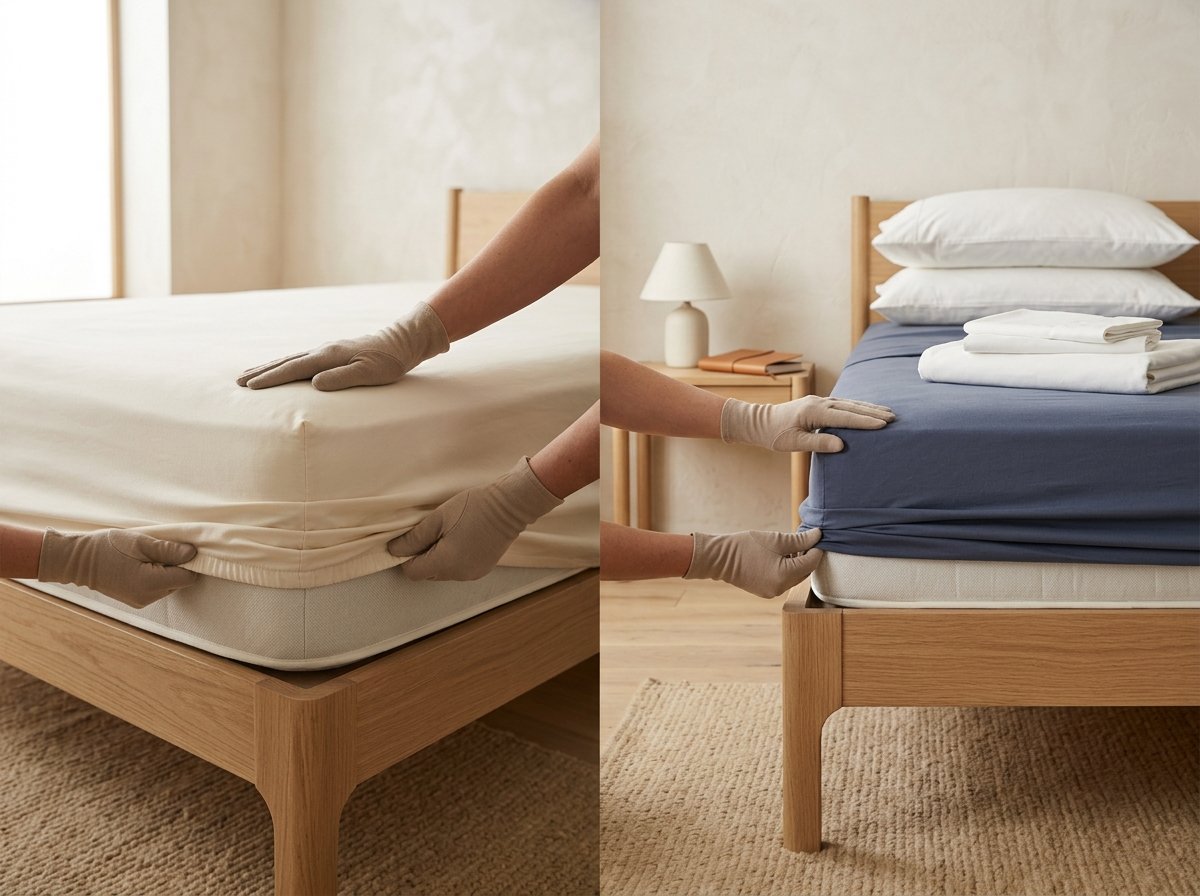

For accommodation that turns over beds frequently, the choice between fitted and flat sheets affects daily labour, not just comfort. Here’s how they compare.
Speed of bed-making
Fitted sheets wrap around the mattress with an elasticated edge, so they go on faster and don’t need tucking — a real time saver when staff are changing many beds in a day. Flat sheets take longer to tuck neatly and are more likely to come loose during use.
Staying in place
Fitted sheets hold their position through the night and during transport of bedding for laundering, reducing the chance of a sheet bunching up or slipping off the mattress corner. Flat sheets are more prone to shifting, especially on thinner camp mattresses.
Cost and flexibility
Flat sheets are usually slightly cheaper and fit a wider range of mattress sizes without needing an exact match, since they aren’t shaped to the mattress. Fitted sheets need closer sizing to your specific mattress dimensions, so confirm sizes carefully before bulk ordering.
Laundering considerations
Fitted sheets can take marginally longer to fold for storage but launder just as easily as flat sheets. If storage space is limited, factor this into your decision.
Our recommendation
For labour camps and high-turnover staff accommodation, fitted sheets generally save more time and reduce complaints about sheets slipping. For hotels wanting a classic, uniform presentation, a flat top sheet paired with a fitted bottom sheet is the standard combination.
Quick comparison:
- Fitted: faster to fit, stays in place, needs closer size match
- Flat: cheaper, more universal fit, more prone to shifting
- Most hotels use both together; camps often prefer fitted alone for speed